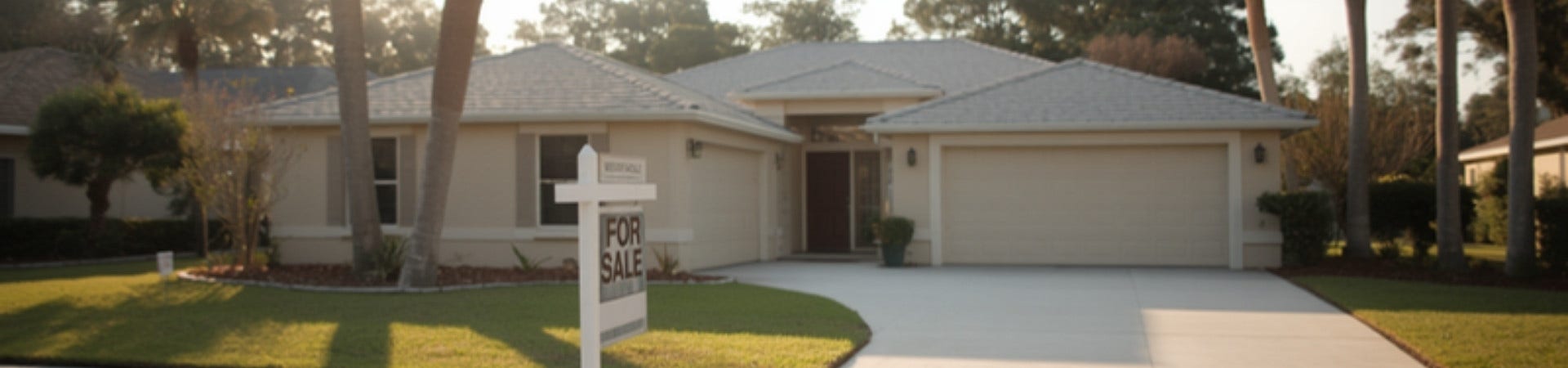
Statewide, Florida's market is holding steady on price while supply tightens. In the greater Daytona Beach and Palm Coast corridor, the numbers tell a different, more buyer-friendly story — and that gap is exactly what investors should be watching.
Two Florida Housing Markets, One Month of Data
Florida Realtors released its statewide August 2026 housing report on September 16, and the headline was stability: prices holding, sales cooling slightly, inventory getting tighter. Read that report next to what's actually happening in Daytona Beach and Palm Coast, though, and the picture splits in two.
Statewide, Florida's single-family median price rose to $415,000 in August 2026, up just over 1% year-over-year, while active inventory fell 13% — a market where sellers are still holding ground. In Daytona Beach, by contrast, the median sale price was $294,852 in July 2026, down 4.9% year-over-year, and in Palm Coast the median sat at $349,810 in June 2026, essentially flat, with sales volume up 11.1%. For investors deciding where in Florida to put capital right now, that divergence — a state market that's tightening while its own Central Florida coastal corridor is still giving buyers real room — is the story worth understanding before the next offer.
What the Statewide Numbers Actually Say
Florida Realtors Chief Economist Dr. Brad O'Connor summarized the state's August data plainly: "Sales remain relatively stable, inventory continues to tighten, and home prices are holding up well despite mortgage rates that remain challenging for many buyers." The specifics behind that:
- Single-family closed sales fell about 1.5% year-over-year; condo/townhouse closed sales fell just under 2%.
- Single-family pending sales declined, ending a 12-month streak of year-over-year gains — the first real crack in that trend line in a year.
- Condo pending sales rose slightly, extending a 13-month growth streak.
- Median prices rose to $415,000 for single-family homes (+1%+ year-over-year) and just under $298,000 for condos (+~3%).
- Active inventory fell 13% for single-family homes and 11.5% for condos compared to a year earlier — the tightening that's helping prices hold.
That's a market cooling on volume but not on price — inventory shrinking even as fewer buyers close. It's a landlord- and seller-friendly combination on paper. But it's a statewide blend of Miami condos, Tampa Bay suburbs, and Panhandle rentals — and it doesn't describe what's happening along Florida's east-central coast.
Why Daytona Beach and Palm Coast Are Moving Differently
Redfin's most recent data puts Daytona Beach's median sale price at $294,852 (July 2026), down 4.9% year-over-year, with 393 homes sold that month — down 4.6% from a year earlier — and homes sitting on the market a median of 76 days. Redfin rates it "not very competitive," with a Compete Score of 21 out of 100 and homes drawing an average of two offers. That's a market losing both price and volume at the same time the state as a whole is holding price steady.
Palm Coast tells a more mixed story. Redfin's June 2026 data shows a median sale price of $349,810, essentially flat year-over-year, but with 825 homes sold that month — up 11.1% from a year earlier — and days on market improving to 71 (from 76). Palm Coast rates as "somewhat competitive" (Compete Score 32/100), with homes selling at 97.7% of list price on average. More homes are changing hands there, at roughly the same price, in less time — a healthier volume story than Daytona Beach's, even without price growth.
Bottom Line: Daytona Beach is cooling on both price and volume. Palm Coast is holding price while gaining volume. Neither is behaving like the statewide market Florida Realtors just described, where shrinking inventory is propping prices up. Flagler County's own months-of-supply figure — 5.1 months as of June 20, per Momentum Realty's live scorecard — sits closer to a balanced-to-buyer's market than the inventory-starved conditions the statewide data implies.
The Mortgage Rate and Insurance Backdrop
None of this is happening in a vacuum. The average 30-year fixed mortgage rate stood at 6.95% as of September 17, 2026 — up 7.1% over the past year and sitting at roughly the 93rd percentile of its historical range, a real affordability headwind that's almost certainly part of why Daytona Beach's sales volume has softened.
Insurance, at least, has been trending the other direction. Citizens Property Insurance Corporation implemented an average 8.7% rate reduction on multiperil homeowners policies earlier in 2026 — more than triple its initially proposed 2.2% cut — as 17 new private insurers entered the Florida market and Citizens shed more than a million policies since 2023. As of a July 2026 snapshot, Volusia and Flagler counties both carry an estimated average annual premium of about $3,850 for $300,000 in dwelling coverage — below several other Florida coastal counties, though individual quotes vary significantly by roof age, construction type, and flood exposure. Improving insurance conditions help the investment math even where home prices themselves aren't moving.
What Homebuilders Are Telling Us About What Comes Next
A late-summer poll of 127 senior homebuilding executives (Builder Advisor Group and Avila Real Estate Capital, reported by Florida Realtors) found builder confidence had dropped from 45% in winter 2026 to just 24% by mid-year, with the share expecting weaker conditions rising from 12% to 38%. Buyer demand uncertainty was the top-cited concern (42%), and builders are actively holding or cutting speculative starts to match actual buyer activity rather than building ahead of demand.
That matters for the Daytona Beach/Palm Coast corridor specifically: less speculative new construction, if it holds through 2027, is exactly the kind of supply discipline that eventually firms up pricing in a market currently working through softer demand — much the way tightening inventory has already propped up prices statewide.
What This Means for Investors
Is now a good time to buy investment property in Daytona Beach or Palm Coast? The honest answer is that both markets currently favor buyers more than the Florida average does — Daytona Beach on price, Palm Coast on negotiating leverage and time-on-market, even without a price discount. Daytona Beach's 4.9% year-over-year price decline and soft Compete Score give buyers real room to negotiate, but that same softness reflects genuine demand hesitancy that a rental or resale plan needs to underwrite honestly, not just treat as a discount. Palm Coast's rising sales volume at a flat price suggests steadier underlying demand, which matters more for an investor planning to hold and lease than to flip.
For out-of-state and portfolio investors comparing Florida markets, the practical read is this: the statewide "inventory is tightening" narrative is true in aggregate but doesn't automatically apply to any single submarket, including two of Newkirk's own home-base counties. Realtor.com's late-fall buyer-window analysis pegged nearby Orlando's best week for negotiating leverage at October 25–31 — competition down 38% from peak, listings up 12.3% — a useful proxy for the broader I-4-adjacent Central Florida timing pattern, even though it doesn't measure Volusia or Flagler directly.
Pro Tip: Before assuming a discount in Daytona Beach or a steady-volume story in Palm Coast applies to a specific property, pull the actual comps for that ZIP code and property type — both cities' countywide averages blend very different housing stock, from beachside condos to inland new construction, and a citywide median can mask a submarket moving in the opposite direction.
The Investor Takeaway
Florida's statewide housing market is leveling off — prices holding, volume softening, inventory tightening. Daytona Beach and Palm Coast are not following that script in lockstep: Daytona Beach is giving up both price and volume, while Palm Coast is holding price and gaining volume, and Flagler County's own supply data reads closer to a buyer's market than the state's inventory-starved headline. For investors with capital ready to deploy in Volusia or Flagler County, that gap between the statewide narrative and the local numbers is where the opportunity — and the due diligence — actually lives. Watch whether builders' pullback on speculative starts starts to firm up local pricing over the next two to three quarters, and underwrite each specific submarket rather than the county average.
Work With Newkirk
If you're evaluating whether Daytona Beach, Palm Coast, or another Volusia or Flagler County submarket fits your investment timeline, Newkirk Investments can walk through current inventory, comparable sales, and the real cost-to-own math on a specific property. Reach the team at Newkirk Investments, 1230 North US Hwy 1, Suite 3, Ormond Beach, FL, 386-290-5356, hello@newkirk-investments.com, or explore current investment-property listings at newkirk-investments.com.
Sources
- Florida Realtors — Florida housing market levels off in August, September 16, 2026 — statewide closed/pending sales, median prices, inventory figures, and the Dr. Brad O'Connor quote
- Florida Realtors — Late fall could provide Florida buyers' edge, September 17, 2026 — Realtor.com/Hannah Jones seasonal buyer-window analysis for Orlando and other major Florida metros
- Florida Realtors — Homebuilders turn cautious on second-half outlook, September 2, 2026 — builder-sentiment poll data (Builder Advisor Group/Avila Real Estate Capital, via HousingWire)
- Redfin — Daytona Beach, FL Housing Market — median sale price, year-over-year change, days on market, homes sold (July 2026)
- Redfin — Palm Coast, FL Housing Market — median sale price, year-over-year change, days on market, homes sold (June 2026)
- Momentum Realty — Palm Coast Housing Market Data — Flagler County months-of-supply figure (as of June 20, 2026)
- MacroRadar — 30-Year Mortgage Rate Today — national average 30-year fixed mortgage rate (September 17, 2026)
- FloridaHomeInsurance.com — 2026 Average Florida Homeowners Insurance Rates by County — Volusia and Flagler County average annual premium estimates (July 3, 2026)
- Alice Cooper Team — Florida Insurance Rates Dropping: What It Means for Daytona Beach Homes, January 13, 2026 — Citizens Property Insurance 8.7% average rate reduction and new-insurer market entry (an earlier-2026 data point used as backdrop)



Responses