A barrier-island condo market with almost no ban risk — and a cost structure that punishes anyone who skips the math.
A Beach Full of Half-Empty Buildings
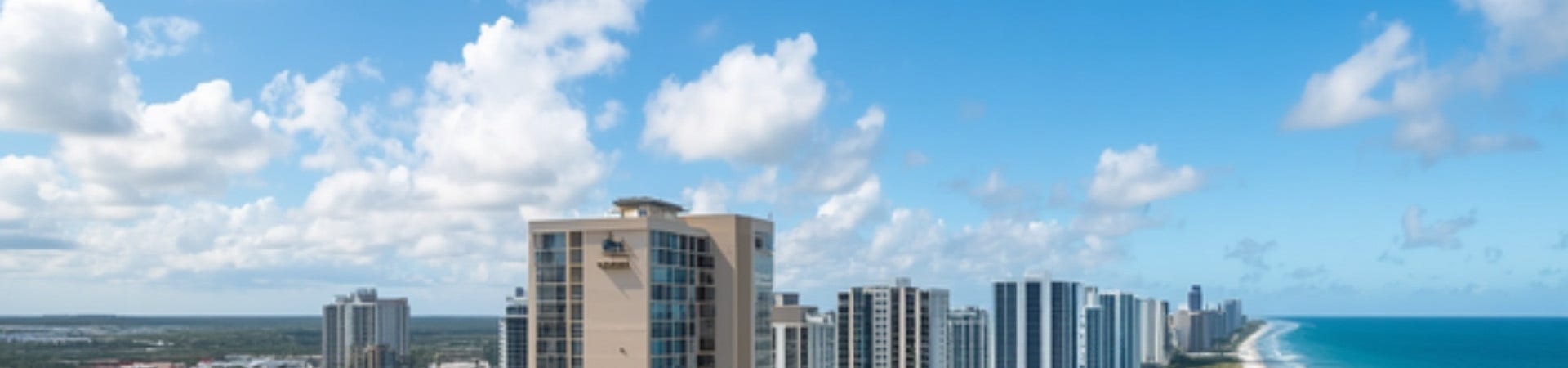
Drive down Atlantic Avenue in Daytona Beach Shores on a Tuesday in November and you'll notice something: a lot of balconies, not a lot of people on them. That's not a red flag — it's the business model. Roughly 80% of the city's residents live in oceanfront high-rise condos built during the 1970s and '80s boom, and more than half of the city's housing units sit vacant at any given time, according to the 2020 Census — not abandoned, but empty because they're second homes, snowbird units, or rentals waiting on their next guest. Daytona Beach Shores has been a rental machine for fifty years. The question for 2026 is whether the machine still pencils out at today's prices and rates.
Daytona Beach Shores is a legal, low-regulation market for short-term rentals — Florida law prevents the city from banning them or restricting how often a unit can be rented, and AirROI's market data rates local STR regulation as "low." But the investment case is more nuanced than the legal case. Market data puts average annual occupancy at just 35% and average gross revenue near $26,971 per listing (AirROI, August 2025–July 2026), while a mortgaged, median-priced condo can easily carry $40,000 or more a year in financing, HOA, tax, and insurance costs before a single cleaning fee or management commission is paid. This is a market where the building you buy in, and how you run it, matters more than the market average.
Here's what the numbers actually say, building by building, dollar by dollar.
The Market: Occupancy, Rate, and Revenue in 2026
Daytona Beach Shores carries roughly 796 active short-term rental listings, according to AirROI's most recent market report (data covering August 2025–July 2026, updated September 12, 2026):
- Occupancy: 35.0% average annual occupancy
- Average Daily Rate (ADR): $277 per night
- RevPAR: $101 (revenue per available rental night)
- Average annual revenue: $26,971 per listing
- Peak month: March, averaging roughly $4,592 in monthly earnings per listing
- Slowest month: November
That 35% occupancy figure is the single most important number in this market. It means the typical listing sits empty about two-thirds of the year — a function of Daytona Beach Shores' seasonal tourism pattern (Bike Week, spring break, summer beach season, and event weekends at Daytona International Speedway drive the peaks) rather than year-round demand like a business-travel market. AirROI itself frames this as a market that "rewards quality listings and strategic pricing" — the average includes a wide mix of professionally managed, highly booked units and occasional, lightly marketed ones, so a well-run listing in a well-located building can outperform the blended average by a meaningful margin.
Bottom Line: This is a seasonal, event-driven vacation rental market, not a steady-income rental market. Budget for the November lull, not just the March peak.
What You Can — and Can't — Do Here
Florida's short-term rental law is built around a 2011 dividing line, and it matters for every investor looking at a Volusia County condo.
Under Fla. Stat. § 509.032(7)(b), local governments generally cannot ban short-term rentals or restrict how often or how long a unit can be rented if their ordinance was adopted after June 1, 2011. Only a handful of grandfathered cities — Miami Beach and Key West among them — still enforce pre-2011 bans. Daytona Beach Shores is not one of them, which is a large part of why the market has developed as it has: no citywide ban risk, unlike some South Florida markets investors research and rule out.
That doesn't mean anything goes. Cities that can't ban rentals can still regulate around the edges, and Daytona Beach Shores condo owners should plan for:
- A Florida DBPR vacation rental license. Any unit rented as a whole entity for stays under 30 days, more than three times a year, needs a license from the Department of Business and Professional Regulation — issued as a Single, Group, or Collective license depending on ownership structure. Licensed units must be inspected, kept in "clean, safe and in good physical condition," and buildings three stories or taller need a Certificate of Balcony Inspection filed every three years.
- Local business tax receipts, occupancy limits, parking rules, and nuisance ordinances, which post-2011 cities like Daytona Beach Shores retain full authority to enforce even though they can't touch rental frequency or minimum-stay length.
- Condo association rules, which in practice matter more than city code. Rental minimums in Daytona Beach Shores are set building-by-building, not citywide — some towers allow weekly rentals, others require month-long or longer leases. Buildings known to permit weekly rentals include 2626 Condo, Aruba, Oasis, Ocean Terrace Club, Ocean Vistas, Opus, Peck Plaza, Sand Dollar, Sandpoint, Sanibel, Sea Fern, Shores Club, Sunglow, and White Surf — but always confirm current rules directly with the association before writing an offer, since these policies do change.
Pro Tip: Skip the city code search and start with the condo docs. In a market built almost entirely on high-rise condos, the HOA's rental policy — not Tallahassee or City Hall — is what actually determines whether your unit can be an Airbnb.
What It Actually Costs to Own and Run One
The condo market itself is not cheap. Redfin puts the median asking price for a Daytona Beach Shores condo at $419,000 as of late August 2026, across roughly 313 active listings, with a median 120 days on market — a slow-moving market that favors buyers willing to negotiate, but it's an asking-price figure, not a confirmed closed-sale median, so treat it as directional.
Run the ownership math on a $419,000 condo bought with 20% down ($83,800) at 7.37% — the 30-year mortgage average as of September 29, 2026, per Forbes Advisor — and the numbers look like this:
- Principal & interest: roughly $2,315/month, or about $27,780/year, on a $335,200 loan
- HOA dues: typically $400–$900+/month in Daytona Beach Shores condo buildings, or roughly $4,800–$10,800/year — this usually bundles the building's master windstorm/hazard policy, water, cable, and amenities
- Property taxes: Daytona Beach Shores' own municipal millage is 4.588 mills for FY2025–26, adopted by the City Commission in July 2025 — but that's only the city's slice. Layer on Volusia County's general fund, school board, and special-district levies (a nearby comparison point: Daytona Beach's combined 2026 rate runs around 19.21 mills, though that's a different city and only directional context) and a Newkirk-estimated combined rate in the high teens is a reasonable planning assumption — call it roughly $7,500–$8,500/year on a $419,000 purchase. Confirm against the Volusia County Property Appraiser's actual bill for any specific unit.
- Flood insurance: Daytona Beach Shores is 93% Zone X (the lower-risk flood designation), yet flood premiums still run an estimated $2,000–$10,000+/year because of oceanfront exposure and condo master-policy economics — a reminder that "low flood risk" on paper doesn't always mean a low bill on a barrier island.
Add it up and a mortgaged, median-priced unit can easily carry $42,000 to $57,000-plus a year in financing, HOA, tax, and flood-insurance costs alone — before cleaning fees, furnishing, utilities, or a management commission. Full-service vacation rental management in this market typically runs 25–40% of gross rental revenue, well above the 8–10% typical for a long-term rental, because of the turnover, guest communication, and cleaning that short-term stays require.
Set that against AirROI's average annual revenue of $26,971 per listing, and the blended market average does not come close to covering the carrying costs on a leveraged, median-priced purchase — before management fees are even subtracted. That's not a reason to avoid this market; it's a reason to buy carefully: a lower price point, a larger down payment, a top-performing building, or a cash purchase changes this math substantially, and top-quartile listings in well-located towers routinely beat the market average that AirROI reports.
Separately, guests — not owners — pay Florida's transient rental taxes: a 6% state tax plus Volusia County's 6% Tourist Development Tax, a combined 12% on stays of 182 nights or shorter. Platforms like Airbnb generally collect and remit this automatically, but owners renting directly are responsible for registering with the county and filing it themselves.
Bottom Line: The legal path to a Daytona Beach Shores short-term rental is wide open. The financial path only works if you run the numbers on your specific building, your specific price, and your specific down payment — not the market average.
The Investor Takeaway
Daytona Beach Shores is one of the least legally risky short-term rental markets in Florida — there's no ban to worry about, and the state constrains how much the city can restrict rental frequency. But 2026's combination of a 7.37% mortgage rate, a $419,000 median asking price, and a market-wide average occupancy of just 35% means the blended numbers don't support a thin-margin, highly leveraged purchase. This market rewards investors who either buy with substantial cash, target a specific well-performing building (start with the confirmed weekly-rental towers above), or treat the unit as a personal beach property with rental income as a bonus rather than the whole thesis. Before writing an offer, pull the specific building's rental policy, request its HOA budget and reserve study, and confirm the DBPR license path for that unit type.
Work With Newkirk
Thinking about a Daytona Beach Shores condo as a rental, a second home, or both? Newkirk Investments can help you pressure-test a specific unit's numbers — building rules, realistic occupancy, and the real cost of ownership — before you make an offer. Reach out to Newkirk Investments in Ormond Beach at 386-290-5356 or hello@newkirk-investments.com, or start with our Volusia County listings to see what's currently on the market along the Volusia coast.
Sources
- AirROI — Daytona Beach Shores, Florida Airbnb Data 2026 — occupancy, ADR, RevPAR, active listings, average annual revenue
- STR Law Map — Florida Short-Term Rental Laws — Fla. Stat. § 509.032(7)(b) preemption framework, 2011 grandfather clause, DBPR license threshold
- MyFloridaLicense.com — DBPR Guide to Vacation Rentals and Timeshare Projects — license types, inspection and balcony-certification requirements
- Redfin — Daytona Beach Shores, FL Condos — median asking price, active listings, days on market (as of Aug. 26, 2026)
- Wikipedia — Daytona Beach Shores, Florida — population, condo housing share, 2020 Census vacancy rate
- Robert Kirkland — 2026 Volusia Flood Insurance Cost by Zone & City — Daytona Beach Shores flood zone mix and premium range
- Volusia County — Tourist and Convention Development Tax — TDT registration and applicability
- FloridaSalesTax.com — 2026 FL Transient/Hotel Rent Tax Rates by County — Volusia County's combined 12% transient rental tax rate
- Airbnb Help Center — Occupancy Tax Collection in Florida — Volusia County 6% TDT collection mechanics
- Citizen Portal — Daytona Beach Shores Proposes 4.588 Mills for FY 2025-26 — city millage rate
- MoveWithMomentum — Volusia County Property Tax Calculator & 2026 Rate — Daytona Beach combined 2026 millage, used as directional context only
- Alice Cooper Team — What to Know Before Buying a Condo as an Investment in Daytona Beach Shores — HOA fee range
- Daytona Luxury Real Estate — One-Week Rental Minimum Condos — named buildings permitting weekly rentals
- Awning — Vacation Rental Property Management in Daytona Beach Shores — STR management fee ranges
- Forbes Advisor — Mortgage Rates Today, September 29, 2026 — 30-year fixed rate, one-year high



Responses