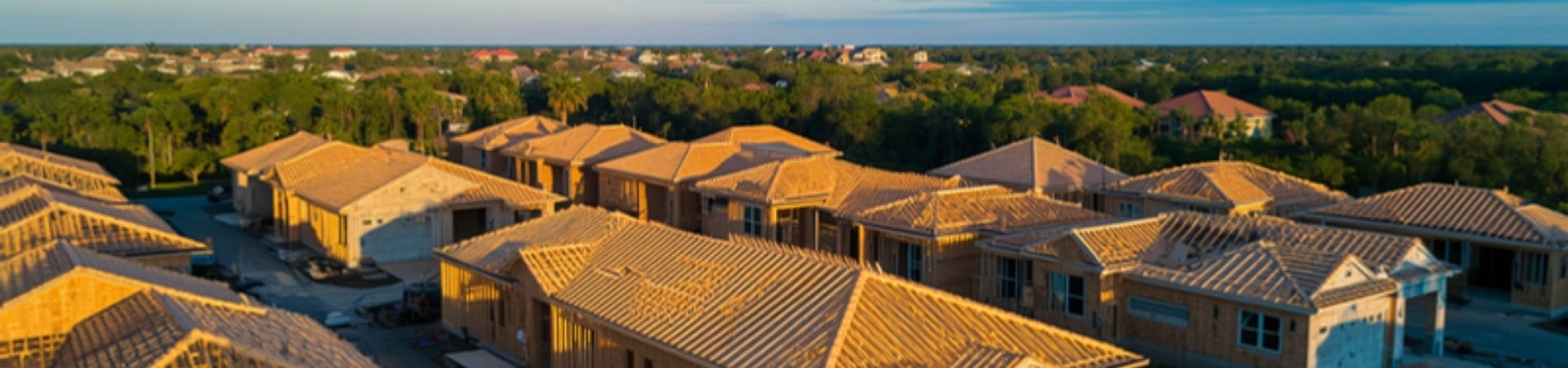
Florida issued 6,184 new residential building permits in September 2026, a 21.1% drop from August's 7,842, according to data from the DeBary-based building permit tracking firm HBW, reported by Florida Realtors. The decline touched all five regions HBW tracks statewide, though Polk, Pasco, and Duval counties bucked the trend with month-over-month gains. In the Jacksonville region, St. Johns County's permit count fell sharply, from 338 in August to 241 in September — a steeper drop than the statewide average. Because permits signal future housing supply rather than homes actually under construction or ready for sale, investors should treat the dip as one data point, not a verdict on where Florida's housing market is headed.
The September Numbers, Statewide
HBW's September snapshot put the total reported construction value of those 6,184 permits at $2.16 billion across the five Florida regions it tracks: Tampa, Southwest Florida, Jacksonville, Orlando, and Southeast Florida. The 21.1% monthly decline reversed much of August's surge, when permit counts jumped 28% from July. September's total of 6,184 actually landed slightly above July's 6,127 — a reminder that August, not September, may have been the outlier month.
HBW itself cautioned against reading too much into any single month. "Monthly permit activity is inherently volatile, and experienced construction professionals know that a single month rarely tells the entire story," the firm wrote in its September report.
Five Regions, One Direction — But Not Every County
Every HBW region recorded fewer permits in September than in August. Tampa remained the busiest region in raw volume, while Southeast Florida continued to carry the highest average construction value per permit.
- Tampa: 1,898 permits, $639.8 million. Polk County rose to 577 permits from 510, and Pasco rose to 524 from 517 — Pasco's $202.8 million in construction value slightly topped Polk's $199.5 million despite fewer permits.
- Southwest Florida: 1,660 permits, $565.9 million. Lee County led the region with 593 permits but fell from 789 in August. Collier County followed with 368 permits and generated nearly as much construction value as Lee despite the lower count.
- Jacksonville: 1,031 permits, $284.8 million, down about 20% in volume from August. Duval County moved against the regional trend, rising to 451 permits from 431, while St. Johns County fell to 241 from 338.
- Orlando: 1,009 permits, $385.3 million. Brevard County dropped to 298 permits from 408, and Lake County fell to 259 from 360, with September construction values of roughly $131 million and $72.8 million, respectively.
- Southeast Florida: 586 permits, $287.6 million. St. Lucie County fell to 237 permits from 353, and Palm Beach County dropped sharply to 104 from 349, driving much of the region's monthly decline.
Average construction values varied widely by region. Southeast Florida's average reported value per permit was $490,704 — more than 77% higher than Jacksonville's regional average of $276,273, the lowest of the five regions. Those figures reflect reported construction values, not asking prices or final sale prices.
Why St. Johns County Is Worth Watching
St. Johns County's drop to 241 permits from 338 — a roughly 29% monthly decline — was steeper than both the statewide 21.1% decline and the Jacksonville region's approximate 20% drop. It also stood in contrast to neighboring Duval County, which added permits during the same month, rising to 451 from 431.
St. Johns County sits inside Newkirk's Central & East Central Florida coverage area, and its building-permit trend is a useful supply-side gauge alongside the county's land and new-construction activity that investors are already watching. A single month of fewer permits doesn't mean St. Johns County development has stalled — Duval's gain in the same region shows county-level results can diverge sharply even within one reporting area — but a steeper-than-average pullback is worth tracking into October's data before drawing conclusions about the county's near-term new-home supply pipeline.
What Permits Actually Tell Investors — and What They Don't
Building permits are a leading indicator, not a delivery schedule. A permit shows a builder has cleared the paperwork to begin construction; it does not establish when that construction will start or when a finished home will reach the market. For investors, permit data is most useful as an early read on where future housing supply — and future competition for buyers, renters, and land — is likely to concentrate, not as a measure of current inventory.
That distinction matters for two groups of Newkirk's audience in particular. Developers and land investors watching entitlement and construction pipelines should treat county-level permit swings as a timing signal worth cross-referencing against local planning and zoning activity, rather than reacting to one month's print. Landlords and rental-property owners should note that a region pulling back on permits today, such as Jacksonville in September, implies comparatively less new competing supply arriving 12 to 24 months from now than a region like Tampa, which kept adding volume even as its regional growth rate cooled.
Reading This Alongside Rising Financing Costs
Florida's permit slowdown arrives as borrowing costs remain a headwind for builders and buyers alike. The 30-year fixed mortgage rate stood at 7.32% as of October 22, 2026, according to Trading Economics — down slightly from a 7.4% two-week peak but still elevated enough to weigh on both builder confidence and buyer demand for newly permitted homes. Higher financing costs can make builders more cautious about pulling permits ahead of firm buyer commitments, which is one plausible contributor to September's statewide pullback, alongside ordinary month-to-month volatility.
The Investor Takeaway
Florida's 21.1% statewide drop in September permits is a real, broad-based pullback, but it followed an unusually strong August and still came in above July's total — context that argues against reading it as the start of a prolonged slowdown. The more actionable signal is at the county level: Duval County kept adding permits while its Jacksonville-region neighbor, St. Johns County, pulled back more sharply than the state as a whole. Investors with exposure to St. Johns County, or considering new positions there, should watch whether October and November permit data confirm the September decline or mark it as a one-month dip, and should weigh that supply signal alongside the current 7.32% mortgage-rate environment when underwriting new-construction or land deals in the region.
Work With Newkirk
Newkirk Investments tracks Florida permit, entitlement, and land-use data across our Northwest Florida and Central & East Central Florida markets so investors don't have to piece it together county by county. If you're evaluating land or new-construction opportunities in St. Johns County or elsewhere in Florida, our team can walk through what the current supply pipeline means for your strategy. Reach Newkirk Investments at 386-290-5356 or hello@newkirk-investments.com.
Sources
- Amy Connolly, "Florida home permits fall 21% in September," Florida Realtors, October 27, 2026 — statewide, regional, and county permit and construction-value figures, and the HBW quote
- HBW, "Florida Residential Construction Snapshot — September 2026" — original data source
- Trading Economics — US 30-Year Mortgage Rate — October 22, 2026 reading of 7.32%



Responses