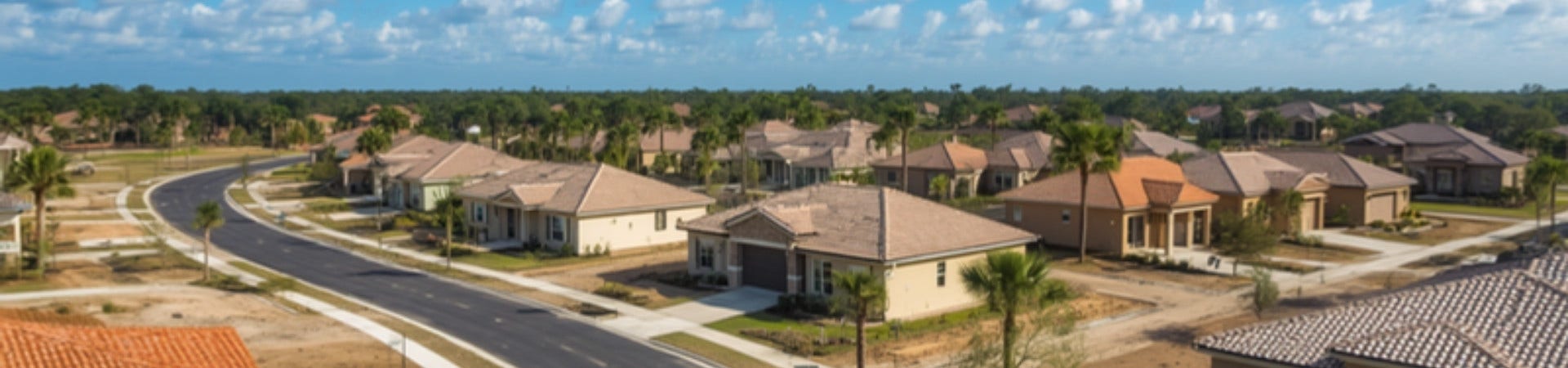
The same City Council meeting that rejected a 78% density increase at an already-under-construction subdivision also approved the city's plan to buy land in Town Center — a split decision that tells investors a lot about how Palm Coast is managing growth in 2026.
A City That Said No to More Homes — and Yes to Buying Land
Palm Coast's City Council denied a developer's request to nearly double the home count at Seminole Trace, a subdivision already under construction in the city's S Section, according to reporting from Flagler County Buzz and other outlets following the council's October 6, 2026 business meeting. The applicants, Byrndog PCP and KL Seminole Trace LLC, had asked the city to raise Seminole Trace's maximum approved unit count from 416 to as many as 743 homes — an increase of 327 units, or roughly 79%. The council said no. At the same meeting, it approved a separate, unrelated item: an update to the State Road 100 Community Redevelopment Area plan that lets the city itself buy parcels inside Town Center. For anyone evaluating entitlement risk or land-banking opportunities in Flagler County, that combination — a hard no on private upzoning, a yes on public land acquisition — is the real story.
Bottom Line: Palm Coast's City Council is not reflexively anti-growth in 2026, but it has shown it will say no to a developer asking to substantially exceed an already-approved density, especially on a site where the council has said no to that same request before.
What Seminole Trace Actually Asked For
Seminole Trace sits on Seminole Woods Boulevard in Palm Coast's S Section, just east of where Seminole Woods meets US-1, and the subdivision is already under construction — homebuilders Dream Finders Homes and Century Communities are both actively selling there, with Dream Finders' current gated "Seminole Trace 60'" section offering single-family homes and villas from the high $300,000s to roughly $480,000 across seven floor plans, 2,213 to 3,285 square feet. The site's current entitlement caps it at 416 homes.
This is not the first time the developers have tried to go bigger. In 2023, they floated a plan for up to 850 homes on the same roughly 331-acre site, and the City Council denied that request. This year's ask — raising the cap to 743 homes, through a Future Land Use Map amendment and a rezoning from SFR-1 and PRS (Planned Residential Subdivision) to a Master Planned Development with a new development agreement — was smaller than the 2023 figure but still represented nearly doubling the subdivision's approved size.
The council first encountered the request at its September 1, 2026 meeting, where it voted 4-1 to table rather than immediately decide. Vice Mayor Theresa Pontieri — the only current council member who was in office when the 2023 request was denied — cast the lone dissenting vote because she wanted to deny the request outright rather than delay it, saying she didn't feel she could "in good faith" approve a return to the developers' earlier ambitions. Council member Charles Gambaro initially proposed a six-month delay before colleagues pushed back on the length; council member Ty Miller's three-month delay motion passed instead. The item returned as a first-read Future Land Use Map amendment and rezoning ordinance on the October 6, 2026 agenda — sooner than the three-month window initially suggested — where the council denied it, according to Flagler County Buzz's October 7 report and corroborating coverage from other outlets the same week.
Not an Isolated Vote
Seminole Trace wasn't the only major density request Palm Coast's council scrutinized this fall. At that same September 1 meeting, the council also tabled a 272-unit proposal called Lakeview Estates, planned for roughly 20 acres of a 280-acre site on the former Matanzas golf course adjacent to the L Section. That vote was also 4-1, with Pontieri citing concerns about what would happen to the rest of the undeveloped acreage and possible chemical contamination from the site's prior use as a golf course, pushing for arsenic testing and a conservation plan for the remaining land.
Read together with Seminole Trace, the pattern is a council willing to pump the brakes on large density increases — particularly on sites with site-specific complications or a history of prior denial — while still processing plenty of other development business. The same October 6 agenda that denied Seminole Trace's expansion also included first reads on Red Mill Pointe, a 216-unit fee-simple townhome master-planned development replacing a previously approved 216-unit multifamily rental project, and an amendment to the Magnolia Trace development agreement that would actually reduce that project's home count from 754 to 624 while adding 4.41 acres and reorganizing its land-use areas. Palm Coast's council isn't blocking growth across the board — it's selectively pushing back on requests to add density beyond what's already been entitled, while still moving routine and even density-reducing proposals forward.
This is a familiar dynamic for Flagler County watchers: Newkirk covered a related story in 2026 when Palm Coast's council ultimately forced Raydient Places + Properties to withdraw a 22,000-home westward expansion proposal rather than approve it as submitted. Seminole Trace is a much smaller project, but the underlying lesson for investors is the same — Palm Coast's council treats an existing entitlement as a ceiling, not a starting point for negotiation, and developers asking to substantially exceed it should expect real scrutiny, not a rubber stamp.
Why This Matters for Flagler County Investors
Palm Coast remains one of Florida's fastest-growing cities — the population was estimated at 114,046 in 2026, up roughly 27% since the 2020 Census, with annual growth still running at about 3.8%, per World Population Review. That growth is exactly what makes a site like Seminole Trace valuable to a developer in the first place, and exactly why the council's willingness to cap density matters to anyone evaluating land or housing investments in the corridor.
For an investor evaluating raw land or an under-entitled parcel in Palm Coast, Seminole Trace is a reminder that the city's approved unit count is the number to underwrite to — not a developer's stated ambition for a future phase. A site entitled for 416 homes should be modeled as a 416-home site until a rezoning is actually approved, not assumed to scale toward a developer's larger pitch. For an investor or homeowner already in the Seminole Woods submarket, the denial caps near-term supply growth at this specific site, which matters locally even though it's a small fraction of citywide inventory — Redfin's three-month data for Seminole Woods put the median sale price at $339,950 in August 2026, down 2.9% year-over-year, with homes selling in a median of 70 days (down from 92 a year earlier) across 44 sales, a cooling but still-active micro-market that a sudden 327-home supply increase next door could have further softened.
The Town Center CRA land-purchase approval at the same meeting is worth watching separately: it signals the city itself is positioning to acquire parcels in its own downtown redevelopment area, a different kind of growth lever than private rezoning and one that could shape where Palm Coast's next wave of public and mixed-use investment lands.
The Investor Takeaway
Palm Coast's City Council denied Seminole Trace's request to add 327 homes on October 6, 2026 — the second time in three years it has rejected an attempt to substantially expand this specific site beyond its approved cap. Combined with September's Lakeview Estates tabling and the broader Raydient precedent, the pattern for land investors and developers eyeing Flagler County in 2026 is clear: Palm Coast's council will process routine development, including some that reduces density, but it is not an easy yes on requests to significantly exceed an already-approved entitlement, especially on sites it has said no to before. Anyone underwriting a Palm Coast land deal with an assumed future upzoning should treat that upzoning as a real, contestable approval to win — not a formality.
Work With Newkirk
Evaluating land or an existing subdivision lot in Palm Coast or elsewhere in Flagler County? Newkirk Investments can help you pressure-test a site's actual entitlement, not just its marketed potential, before you commit capital. Reach out to Newkirk Investments in Ormond Beach at 386-290-5356 or hello@newkirk-investments.com, or explore current investment opportunities at newkirk-investments.com.
Sources
- Flagler County Buzz, "Palm Coast rejects proposal to add homes at Seminole Trace. Approves Town Center land financing," October 7, 2026 — the October 6, 2026 denial and the same-meeting Town Center CRA approval
- Yahoo News / Coral Springs FL News (syndicated), "Palm Coast denies Seminole Trace developer's push for 327 more homes," October 2026 — corroborates the denial and the 416-to-743 figure
- City of Palm Coast, City Council Business Meeting agenda, October 6, 2026 (palmcoast.gov) — Seminole Trace, Red Mill Pointe, Magnolia Trace, and Town Center CRA agenda items
- Ask Flagler, "Palm Coast City Council tables 2 development proposals," September 2026 — the September 1, 2026 tabling votes and the 2023 history
- Observer Local News, "Palm Coast Council delays decisions on two major development proposals," September 3, 2026
- Dream Finders Homes, Seminole Trace community page — home types, floor plans, and pricing
- Redfin, Seminole Woods, Palm Coast housing market data (August 2026)
- World Population Review, Palm Coast, FL population estimate (2026)




Responses